How far the distances really are
Australia covers 7.69 million square kilometres, and its states and territories are large enough that the map itself becomes the planning problem. Western Australia alone accounts for more than 2.5 million square kilometres, and Queensland, the Northern Territory and South Australia each cover close to or more than a million.
That scale is what changes a long ride here. A route that reads like a fortnight of work on a map of Europe can be a month of steady days, and a day that looks short on paper often ends with an hour of riding into a low sun with wildlife starting to move. Plan the trip as a sequence of riding days rather than as a total distance, then test every day against the things that actually slow you down: refuelling stops, park entry points, heat, and the last stretch into wherever you are sleeping.
In practice, a long Australian trip tends to be built around two or three big crossings rather than one continuous line: the run along the southern edge of the continent, the climb into the tropics, or the long haul through the centre. Each of those has to be solved as its own problem, with its own fuel stops and its own weather window, and the rest of the trip can hang off them. The month you choose changes the answer more than the route does, which is why picking the season first is the practical way to start.
Averaging your best day across a whole trip is the most common planning mistake; build the plan around your worst day instead.
What each state rides like
The riding splits roughly into two halves. The south-east is dense with sealed roads, towns and forest, so you can string together long days without ever being far from help. The centre and the north-west are the opposite: the roads are good, the country is vast, and the planning problem is the space between services rather than the road surface itself.
| State or territory | Land area (km²) | What it asks of a rider |
|---|---|---|
| Western Australia | 2,527,013 | Long sealed highways and enormous gaps between towns; the north-west is a season, not a weekend. |
| Queensland | 1,729,742 | Tropical coast in the east, very long inland runs to the west. |
| Northern Territory | 1,347,791 | A wet-season north and an arid centre; the space between services drives the plan. |
| South Australia | 984,321 | Wine country within a day of Adelaide, arid country beyond the ranges. |
| New South Wales | 801,150 | Coast, ranges and inland plains all within a day of each other. |
| Victoria | 227,444 | Compact: tall forest, alpine country and coast close together. |
| Tasmania | 68,401 | Small island, big riding; mountain roads and coast in every direction. |
Park entry fees and permits
National parks hold a lot of the best riding, and the rules change at the park boundary. Some parks are free to enter, others charge a vehicle entry fee that has to be paid before you go in, and others again require a pass bought in advance.
Read the rules for each state you cross rather than assuming the last set still applies. A park alerts page is worth checking the night before a ride, and it is the fastest way to find out that the road you planned to use is closed.
- Some parks charge per vehicle per day and expect payment on arrival, at a pay machine or through the park agency's app.
- Outback parks in South Australia can require a pass: a Desert Parks Pass is mandatory for Munga-Thirri-Simpson Desert National Park and for travel east of Dalhousie Springs in Witjira National Park.
- The Desert Parks Pass covers 12 months of vehicle entry and camping across a whole list of desert parks and reserves, not a single park.
- Speed limits inside parks are lower than the open road: 40 km/h applies within parks in South Australia.
- Check the park agency's alerts before you ride in; outback bulletins list parks and tracks closed for rain, flooding and management work.
Closures are usually listed by road or campground rather than by park, so read the alert list itself and not just the park summary.
Planning fuel range properly
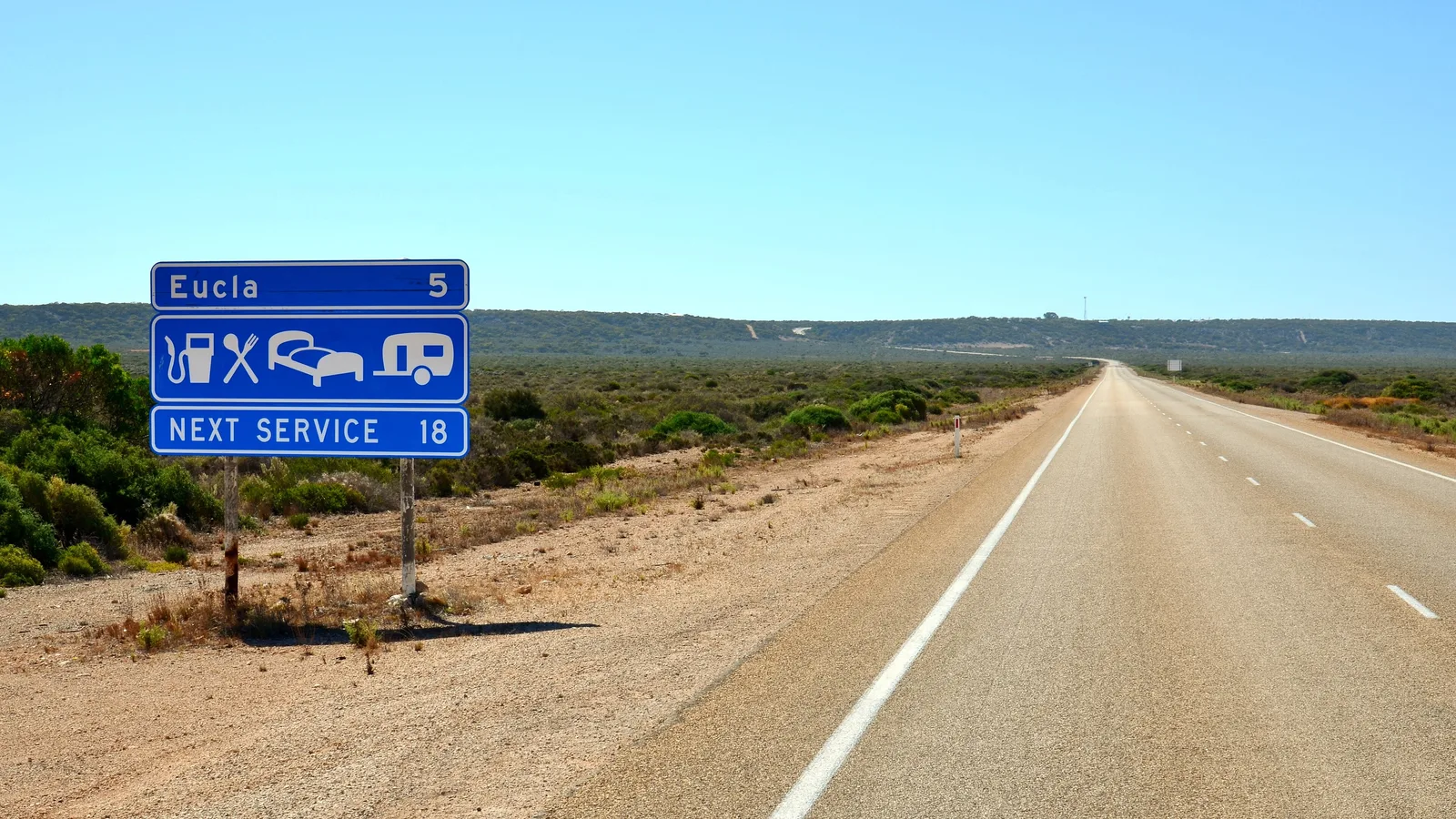
South Australian outback travel guidance is blunt about supplies: take extra water, food and fuel, because between stops there may be nothing at all. Treat your comfortable range as the number you plan around, not the number in the brochure. A loaded bike, a headwind and a long climb all eat into it.
The other half of fuel planning is deciding what you will do when the stretch is longer than the range. Add a container, change the route, or split the day differently — but decide before you leave the last town, not halfway along. The arithmetic behind that is set out in fuel, water and isolation on outback roads, including how much you actually need to carry.
- Work out your real range loaded, at highway speed, before you commit to a remote stretch.
- Refuel at every opportunity that appears rather than only when the gauge says you need to.
- Carry water and food as a separate plan from fuel: a delay in heat is its own emergency.
- Know the distance to the next fuel, and the one after that, before you leave a stop.
- Keep fuel planning conservative; running a tank dry in remote country turns a good day into a long wait.
Roadhouse hours shrink the further out you go, so plan to arrive with daylight to spare.
Weather windows around the country
When you ride matters as much as where. The far north has a wet season that closes roads and parks, and South Australia's outback parks guidance warns that outback daytime temperatures can reach the high 40s Celsius. The alpine country in the south-east gets snow and ice on its high roads, so a route that works in summer can be unusable in winter.
Build the trip around the season rather than against it. Riding the north in the dry season and the south in the shoulder months is the standard shape for a long Australian trip, and it keeps the weather working with you instead of against you.
Significant rain in the far north closes roads and parks outright: outback bulletins list closures caused by flooding.
Wildlife, road trains and heavy traffic
In remote country you share the road with vehicles that behave nothing like the traffic you are used to. A road train is a prime mover pulling two or more trailers, and Main Roads Western Australia puts the range at 27.5 to 60 metres; a 60-metre combination is roughly twelve average cars long.
Animals move most in the hours around dawn and dusk, so shape the riding day so that you finish before the light goes, particularly on rural roads where there is no barrier between the verge and the lane.
Wildlife is the other half of the same problem, and it does not announce itself. Kangaroos and emus move at dawn and dusk, cattle wander onto unfenced verges, and a kangaroo at speed will take a bike out with no warning at all. Riding in daylight is not a comfort measure; it is the single change that removes most of that risk.
- Road trains are limited to 100 km/h like other vehicles towing trailers, and the larger ones to 90 km/h, with lower limits on some roads.
- They accelerate slowly and need far more distance to stop, so never pull in front of one.
- Overtake in an overtaking lane where you can, and be patient where you cannot.
- Watch for turning trucks: a long combination swings wide and may need more than one lane.
- Near the cities the combinations get shorter, up to about 42 metres in the Perth metropolitan area, which does not make them small.
Leave more space again in the rain; a heavy vehicle's stopping distance grows faster than yours does.
Paperwork for visiting riders
Riders visiting from overseas can generally ride on their own licence for a period, but the detail is set state by state. In New South Wales, a temporary overseas visitor can ride on a current overseas licence for up to six months, as long as the licence covers the class of motorcycle, and it must be carried while riding and shown to police if asked.
Length of stay matters too, because a visitor who stays long enough can be required to obtain a local licence. Work that out before you leave rather than at a counter in the middle of a trip. The Australian road rules for motorcyclists guide covers the general shape of what changes between states.
- Carry your licence and evidence of your visitor status, and be ready to produce both.
- Check that your licence class covers the motorcycle you intend to ride.
- Check the rules for every state you plan to enter; they are set state by state, not nationally.
- Documents in another language may need an English translation for official purposes.
Planning for a breakdown
Outback travel guidance assumes you will be self-sufficient: carry communications equipment such as a satellite phone or HF radio and a distress beacon, tell a responsible person where you are going and when you expect to arrive, and take extra water and fuel for delays.
The other half of breakdown planning is mechanical. Know what you can fix by the side of the road, carry the tools and spares for exactly that, and decide in advance which problems mean turning around. A route that would strand you a long way from the nearest town is a risk worth choosing deliberately. If the trip is less about the riding and more about covering the country, campervan hire in Alice Springs covers the same corridors with a bed at the end of the day. If you are basing yourself somewhere between trips, rides out of Alice Springs is the closest thing the Centre has to a starting point.
- Carry a satellite phone or HF radio where there is no mobile coverage, and a registered personal locator beacon.
- Leave your plans with someone who will act if you are late.
- If you get stuck, stay with the vehicle; walking out for help is how people die out there.
- Do not ride through ponded water on remote tracks; it hides washouts and can flood a vehicle's electrics.
- Carry tyre repair gear you have actually used before; there is no practice run in remote country.
Questions riders ask
How far can I ride in a day in Australia?
There is no figure that works everywhere. Build the plan around your own conservative daily average, then reduce it for heat, wildlife light and long fuel gaps. Riders who get into trouble have usually built an itinerary around their best day.
Do I need a permit to ride through Australian national parks?
Sometimes. Many parks are free to enter, some charge a per-vehicle entry fee that must be paid before entry, and outback parks in South Australia can require a pass: the Desert Parks Pass is mandatory for Munga-Thirri-Simpson Desert National Park and for travel east of Dalhousie Springs in Witjira National Park. Check each park's alerts and fees before you arrive.
Is fuel available everywhere?
No. South Australian outback guidance is to take extra water, food and fuel because supplies between stops can be scarce. Plan your range conservatively and refuel whenever the opportunity appears.
What licence do I need as an overseas visitor?
Riders can usually use their overseas licence for a period, but each state sets its own rules. In New South Wales a temporary overseas visitor can ride for up to six months on a current overseas licence that covers the motorcycle class, carrying it at all times. Check the rules for every state you plan to enter.
What actually closes a route?
Rain and park management, mostly. Significant falls of rain in the far north close parks and cut roads, and outback bulletins list the closures caused by flooding alongside track closures for management work. Read the alert list the night before a remote day rather than on the morning.
Sources
- Geoscience Australia — How large is Australia? Areas of states, territories and deserts — ga.gov.au
- National Parks and Wildlife Service South Australia — Desert Parks Bulletin(parks.sa.gov.au)
- National Parks and Wildlife Service South Australia — Desert Parks Pass(parks.sa.gov.au)
- Main Roads Western Australia — Road Train Domain(mainroads.wa.gov.au)
- NSW Government — Driving with an overseas or interstate licence in NSW(nsw.gov.au)